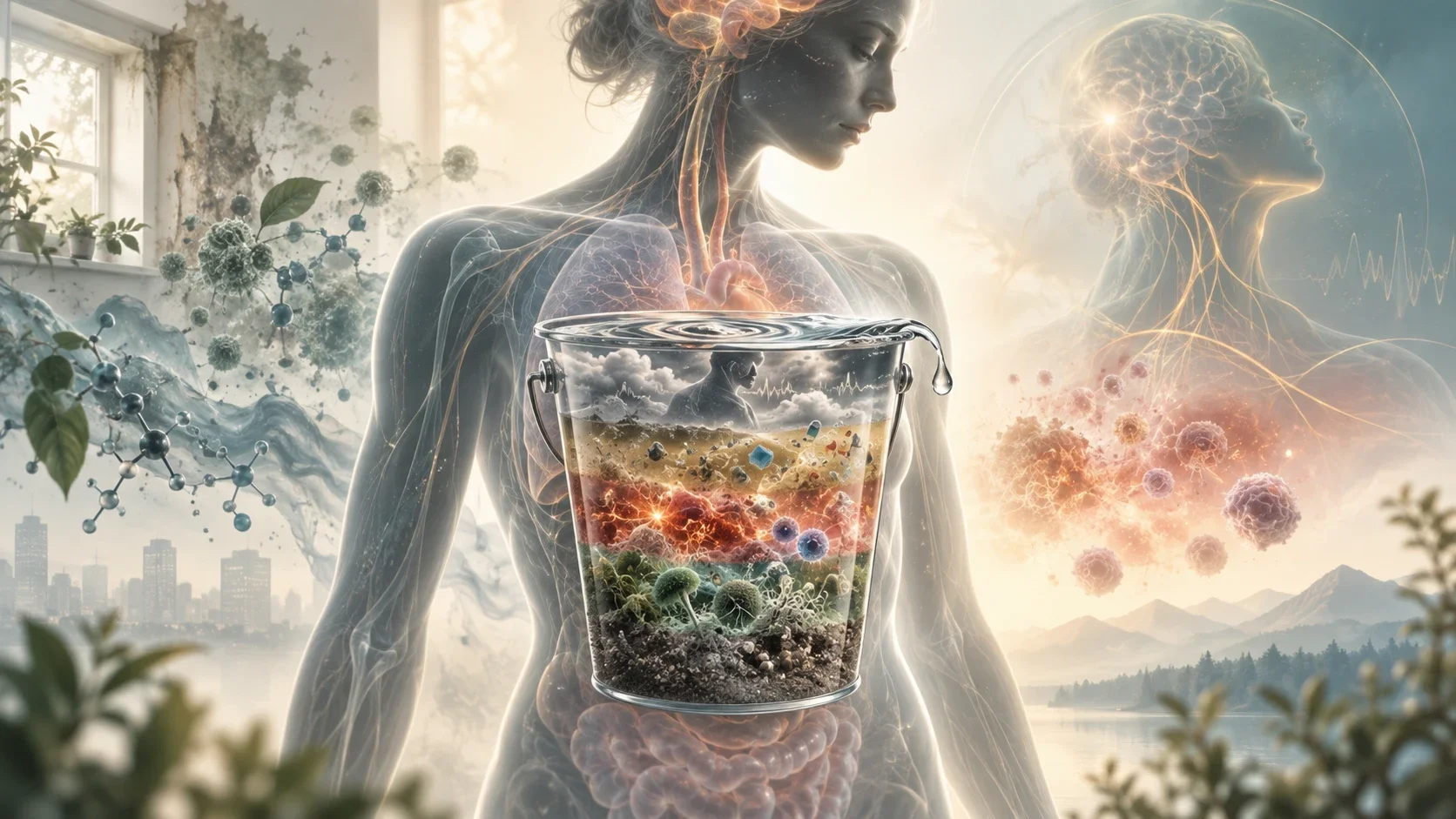
Have you ever wondered why you can eat the same foods and live the same lifestyle as your friends, yet you're the one struggling with chronic fatigue, digestive issues, skin problems, or unexplained symptoms? The answer often lies in understanding what I call the "toxic bucket" concept, a simple yet powerful way to visualize why some people develop health issues while others seem immune.
The bucket isn't just a metaphor I like. Science has its own names for the same idea: allostatic load, the cumulative wear and tear that stress mediators leave on the body over time, and the exposome, the sum of everything we are exposed to across a lifetime, from the womb onward. The bucket simply puts those ideas into a picture you can hold in your mind.
What Is The Toxic Bucket?
Imagine your body has an invisible bucket that gradually fills throughout your lifetime. This bucket collects various stressors, some you can see and others you can't. Every day, small amounts of different toxins and stressors get added:
- Environmental toxins from air pollution, cleaning products, fragrances and personal care items
- Food-related stressors like pesticides, food additives, and inflammatory ingredients
- Heavy metals such as lead, mercury, cadmium, arsenic and aluminum, from old paint and pipes, dental work, fish, rice, cookware and industry
- Industrial chemicals from plastics, flame retardants in furniture and electronics, and other everyday materials
- Mold and mycotoxins from water-damaged buildings or contaminated foods, along with the bacteria and endotoxins that grow alongside them
- Chronic and stealth infections such as parasites, bacteria, fungi and viruses, including tick-borne infections like Lyme, Bartonella and Babesia
- Spike protein, from infection or vaccination, which in some people keeps the immune system and mast cells on alert long after the event
- Oxalates, from food and from within: Candida and many molds make oxalates, so a fungal problem can quietly raise the oxalate load
- EMF, the constant electromagnetic exposure of modern life, which I see adding to the load in sensitive people
- Emotional and physical stress that keeps your nervous system in overdrive
- Nutrient and mineral deficiencies that prevent your detoxification systems from working properly
When The Bucket Overflows
Here's the critical part: everyone's bucket is a different size. Your genetic makeup, early life experiences, and overall health determine your bucket's capacity. Some people have large buckets and can handle more stressors before symptoms appear. Others have smaller buckets, or buckets that have been damaged by early trauma, infections, or genetic predispositions.
When your bucket finally overflows, that's when symptoms begin to manifest. This explains why:
- Two people can have the same mold exposure, but only one gets sick
- You might feel fine for years, then suddenly develop multiple symptoms seemingly overnight
- Your symptoms might seem unrelated but actually stem from the same root cause: an overflowing toxic bucket
I have lived this myself. Our family went through mold in two homes, and I felt firsthand how quickly a bucket can overflow. You can read that story in Mold in a Newly Built Home.
Two Ways to Heal: Empty the Bucket, and Make It Bigger
Most people think of healing as emptying the bucket: removing what's filling it. That matters enormously, but it's only half the picture. The other half is capacity: how big the bucket is, and how well it drains. Healing works best when we do both at the same time.
Your capacity depends on:
- Drainage: bowels that move every day, bile that flows, kidneys, lymph and skin that can carry toxins out. If these are blocked, anything we stir up has nowhere to go
- Minerals and nutrients: every detox enzyme and antioxidant system runs on minerals like zinc, magnesium, selenium and molybdenum. I explain this in depth in Happy Mold vs Angry Mold, Part II
- The nervous system: a body stuck in threat mode shunts resources away from repair and digestion. Calming the nervous system and mast cells makes the whole bucket bigger. I explain why in Mast Cells: When Your Body Reacts to Everything
- The gut and its barrier, where much of the immune system learns what is friend and what is foe
- Mitochondria and sleep, the energy and repair systems that everything else depends on
This is why some people feel worse when they jump straight into an aggressive detox. They are pouring out of a bucket that has no drain. Build capacity before anything that stirs toxins up, and emptying the bucket becomes far gentler.
Heavy Metals: The Layer We Often Miss
I know I talk a lot about mold, but heavy metals are part of people's profiles quite often too. My advanced health questionnaire helps me connect specific symptoms to the type of metal that may be involved, so testing is targeted rather than a guess.
This is also where hair tissue mineral analysis (HTMA) shines. I often find heavy metals low in urine even when they show up on HTMA. HTMA reflects what has been deposited in tissue over the past few months rather than what happens to be leaving the body on the day of the test.
And when I support detoxification, I often see those levels rise on excretion testing. That can look alarming, but it is actually a good thing: it means excretion is improving and the body is finally moving what it has been holding. It also tells us that the true body burden is often much higher than excretion testing shows at first.
What I See in Practice
I have had many clients come to me with a mixed constellation of symptoms, saying, "No one can tell me what is wrong with me." Their bloodwork has been "normal" for years. They have been told it's stress, age or anxiety.
So we run tests, and we find a lot. Many times that includes a heavy load of metals, along with chemicals: flame retardants, pesticides, industrial chemicals and more. Suddenly the symptoms make sense, because each of these fills the same bucket.
Within a few months of working through it, in the right order, the person can feel completely different. In many cases I have seen skin improve significantly, hair regrow and meaningful weight loss happen, alongside better energy and sleep. Not everyone moves at the same pace, and there are often ups and downs along the way, but when the bucket starts to empty and the drain opens, the body responds.
Most often, I see this kind of turnaround in people who aren't chronically ill. They just don't feel well, and they know something is wrong. One client in her seventies put it this way:
“Over the past two years I started to feel increasingly lethargic and was gaining weight… feeling bloated, tired, and sleeping far too much… my energy levels and digestion improved noticeably within three months… I can honestly say I feel great again — energetic, clear-headed, and back to my old self.”
— Marie, 77 (Google review)
I also work with people who are chronically ill, and metals and chemicals are part of their profiles too. But their picture usually involves a lot more biochemical complexity, and a considerably larger role for pathogens and infections, so their healing journey tends to be longer and move in more layers.
“I've been chronically ill for the past 11 years. Since beginning to work with Katka, I've made more progress and uncovered more answers about my health than I had on my own over the past decade of painstaking self-experimentation and research.”
— Eric F. (Google review)
The Interconnected Web
What makes this concept even more complex is that your body's systems are deeply interconnected. When your toxic bucket overflows, it doesn't just affect one area; it creates a cascade effect:
- Gut dysfunction can trigger immune responses that show up as skin issues, brain fog, cognitive decline, joint pain, insomnia and reflux
- Chronic stress can disrupt hormone production, affecting energy and mood, and can directly contribute to gut dysfunction and mineral imbalances
- Detoxification problems can lead to inflammation that impacts liver, kidney, lymph, cardiovascular and brain function
- Nutrient deficiencies can prevent your body from managing any of the above effectively, and are typically found alongside all of them
You can see the bucket at work in every one of my deeper articles: in the skin (What Your Skin Is Trying to Tell You), in hormones (When Estrogen Steals the Show), and in the brain (Neuroinflammation).
This is why addressing symptoms in isolation often provides only temporary relief. The real solution lies in emptying the bucket, making it bigger, and using targeted supports to help the body restore lost balance.
Your Body's Amazing Healing Capacity
Here's the empowering part: your body has an incredible innate ability to heal itself when given the right conditions. Think of it as your body's natural maintenance crew that works around the clock to repair damage, fight infections, and maintain balance. But this crew can't do their job effectively when they're constantly overwhelmed by an overflowing toxic bucket.
When we identify what's filling your bucket and systematically remove these stressors, something remarkable happens. Your body's natural healing mechanisms can finally get to work. The inflammation decreases, energy returns, digestion improves, and that brain fog lifts.
The Individual Approach
This is why cookie-cutter health programs often fail. Your toxic bucket is unique to you. What fills your bucket might be completely different from what fills your family's or friends' buckets. This is where functional laboratory testing becomes invaluable: it helps us see what's actually in your bucket rather than guessing.
Through comprehensive testing, we can identify:
- Which infections your immune system is fighting
- How well your detoxification pathways are functioning
- What nutrient and mineral imbalances are preventing optimal function
- Which heavy metals, mycotoxins and chemicals are present, and where they are being stored
- Which foods are creating inflammatory responses
- How your stress response systems are coping
Emptying Your Bucket: The DRESS Approach
Once we know what's in your bucket, the order depends on you, but a few principles protect everyone: the exposure has to come down, and drainage and binders need to be in place before anything that mobilizes toxins or targets deeper infections. I show how these layers fit together on my approach page. Underneath all of it sits the DRESS foundation:
- Diet: Removing inflammatory foods and adding nutrient-dense, healing foods
- Rest: Optimizing sleep and recovery to support your body's natural repair processes
- Exercise: Appropriate movement that supports detoxification without adding stress
- Stress Management/Nervous System Regulation: Regulating your nervous system to break the chronic stress cycle
- Supplementation: Targeted nutrients based on your specific deficiencies and metabolic needs
The Journey Forward
Emptying your toxic bucket isn't an overnight process. It's a journey that requires patience, commitment, and the right support. But here's what makes it incredibly rewarding: as your bucket empties and grows, you don't just feel better temporarily. You're actually restoring your body's ability to self-regulate and maintain optimal health long-term.
You'll learn to recognize what fills your bucket and how to keep it from overflowing again. You become empowered with the knowledge and tools to maintain your health rather than just managing symptoms as they arise.
Your Bucket, Your Choice
The toxic bucket concept isn't meant to overwhelm you; it's meant to empower you. Understanding that your symptoms have identifiable root causes means those causes can be addressed. Your body wants to heal. It just needs the obstacles removed and the right support provided to allow it to use its innate intelligence to heal.
If you're tired of managing symptoms and ready to empty your bucket, know that this journey is possible. With the right testing, guidance, and commitment to the process, you can restore your body's natural balance and reclaim your health.
Selected references and further reading
Key studies and reviews behind the mechanisms described above. Many of the patterns in this article also come from clinical experience shared across practitioners, which doesn't always have a single paper behind it.
Cumulative load: the science behind the bucket
- McEwen BS. Protective and damaging effects of stress mediators. N Engl J Med. 1998;338(3):171-179. PubMed 9428819
- Wild CP. Complementing the genome with an "exposome": the outstanding challenge of environmental exposure measurement in molecular epidemiology. Cancer Epidemiol Biomarkers Prev. 2005;14(8):1847-1850. PubMed 16103423
- Furman D, Campisi J, Verdin E, Carrera-Bastos P, Targ S, Franceschi C, et al. Chronic inflammation in the etiology of disease across the life span. Nat Med. 2019;25(12):1822-1832. PubMed 31806905
Early life and individual susceptibility
- Felitti VJ, Anda RF, Nordenberg D, Williamson DF, Spitz AM, Edwards V, et al. Relationship of childhood abuse and household dysfunction to many of the leading causes of death in adults. The Adverse Childhood Experiences (ACE) Study. Am J Prev Med. 1998;14(4):245-258. PubMed 9635069
Mold and damp buildings
- Mendell MJ, Mirer AG, Cheung K, Tong M, Douwes J. Respiratory and allergic health effects of dampness, mold, and dampness-related agents: a review of the epidemiologic evidence. Environ Health Perspect. 2011;119(6):748-756. PubMed 21269928
Heavy metals and chemicals
- Tchounwou PB, Yedjou CG, Patlolla AK, Sutton DJ. Heavy metal toxicity and the environment. Exp Suppl. 2012;101:133-164. PubMed 22945569
- Sears ME, Kerr KJ, Bray RI. Arsenic, cadmium, lead, and mercury in sweat: a systematic review. J Environ Public Health. 2012;2012:184745. PubMed 22505948
- Linares V, Bellés M, Domingo JL. Human exposure to PBDE and critical evaluation of health hazards. Arch Toxicol. 2015;89(3):335-356. PubMed 25637414
- Gore AC, Chappell VA, Fenton SE, Flaws JA, Nadal A, Prins GS, et al. EDC-2: The Endocrine Society's Second Scientific Statement on Endocrine-Disrupting Chemicals. Endocr Rev. 2015;36(6):E1-E150. PubMed 26544531
Gut, stress and the brain
- Vanuytsel T, van Wanrooy S, Vanheel H, Vanormelingen C, Verschueren S, Houben E, et al. Psychological stress and corticotropin-releasing hormone increase intestinal permeability in humans by a mast cell-dependent mechanism. Gut. 2014;63(8):1293-1299. PubMed 24153250
- Cryan JF, O'Riordan KJ, Cowan CSM, Sandhu KV, Bastiaanssen TFS, Boehme M, et al. The Microbiota-Gut-Brain Axis. Physiol Rev. 2019;99(4):1877-2013. PubMed 31460832